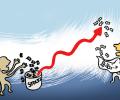
In absolute terms, the year closed with the market capitalisation of all BSE-listed companies rising by Rs 45.5 lakh crore to Rs 152 lakh crore, or an increase of 42.8 per cent, compared to the closing value on December 30, 2016, says Pavan Burugula.
Decline in the rupee coupled with a slide in the crude oil prices have dented the sentiments.
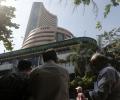
The S&P BSE Sensex ended the day at 28,226, up 85 points, while the Nifty50 settled at 8,734, up 18 points.

Strong MF investments, stemming of FII outflows and positive earnings in Q3 have helped market, say analysts.

The top losers from the Sensex pack are ONGC, Coal India, Vedanta, Reliance Inds and L&T.

In prior elections, not only have opinion poll forecasts been very different from the results, the error margin has increased over time. One need only look at the charts that show the Sensex half a year before and after the results day for the last six elections. The markets did not change direction in any, says Neelkanth Mishra.

Most Asian markets ended with gains.

The Sensex ended above 27,000 for the first time while the Nifty topped 8,100.

Broader markers outperformed their larger peers.

Most Asian stock markets steadied on Wednesday.

Liquidity pushed benchmark indices 22% higher to become the best performing equity market globally
There has been no reboot of the private investment cycle.

Other Sensex gainers were Infosys, Wipro, ICICI Bank, Hero MotoCorp, L&T, Axis Bank,, Tata Steel, HDFC and Cipla.

Aggressive rate hikes by the US Federal Reserve could result in a flight of capital from emerging markets like India, says B Gopkumar, chief executive officer, Reliance Securities.

A declining rupee, elevated crude oil prices and sustained foreign fund outflows added to the gloom

EM asset classes could rally if the pace of US Federal Reserve rate increases moderates.

Mahesh Nandurkar, executive director and India Strategist at CLSA, talks to Puneet Wadhwa ahead of their 21st India Forum on his interpretation of how the markets have played out over the past few months, the road ahead, and his sector preferences in this backdrop.
The benchmark BSE Sensex reclaimed the 28,000 mark, spurting by 409 points or 1.4% at 28,114 and Nifty settled above the 8,500 mark at 8,532, gains of 111 points.

Sensex slumped 518 points to end the day at 25,582 and the Nifty slipped 164 points to close at 7,623.

Sesnsex ended the day flat on heavy selling pressure.

Sensex firm on favourable GDP numbers for FY16.

Rate sensitive sectors rallied the most led by banks while metals surged on rebound in commodity prices
Financials were the top gainers lead by private lenders ICICI Bank and HDFC Bank

When big offers hit the market, broader indices corrected 2-4%

Among the private banking majors ICICI Bank and HDFC Bank were down 0.2%-0.5% each.

The 30-share Sensex ended down 538 points at 26,781 and 50-share Nifty ended down 152 points at 8,067.

Indices reversed all its losses during late trades.

'We are in the middle of an unprecedented SIP revolution.' 'Monthly inflow through SIPs will be Rs 15,000 crore to Rs 20,000 crore soon.' 'Traditional avenues of Indian savings like bank fixed deposits, gold or real estate are no longer attractive to invest.'

Financial shares were the top losers.

The S&P BSE Sensex ended 190 points up at 23,382.

Nitin Desai suggests some concrete measures to revive investment and boost growth.

Among key stocks, Tata Motors, Hero MotoCorp, L&T, Wipro, ICICI Bank, Dr Reddy's Labs and ICICI Bank, all up between 1%-3%

With an m-cap of Rs 31,744 crore, IRCTC stood at 96th position in the overall market capitalisation ranking, the BSE data shows.

The 30-share Sensex ended up 248 points at a record closing high of 27,346.
The 30-share Sensex ended down 224 points at 28,442 and the 50-share Nifty ended down 101 points at 8,606.

Investment in market leaders with a safety-first approach could yield reasonable returns across sectors.

Investor wealth on Wednesday diminished by Rs 1.84 lakh crore amid massive sell-off in the equity market.

Market players say following the tax cuts, the market mood had changed from bearish to positive, which should help sustain the rally.

Investment banking star and Moelis India Chief Executive Officer Manisha Girotra remembers a colleague who wanted to resign because she needed to attend to her parents' health issues in a different state. Rather than quit a promising career, she was given the flexibility of working from home on Fridays, which was unusual in the pre-pandemic days. This allowed her to take care of her parents' visits to the doctor and other health-related needs without quitting her job. She would be back in the city office on Mondays.

It's the beginning of a rate reduction cycle
